
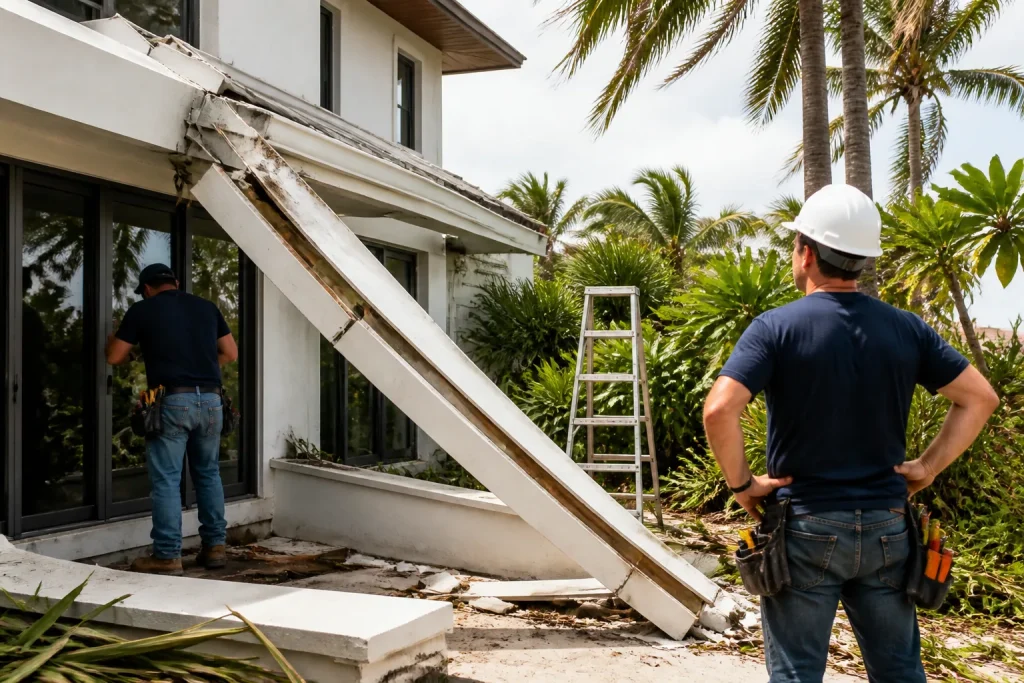
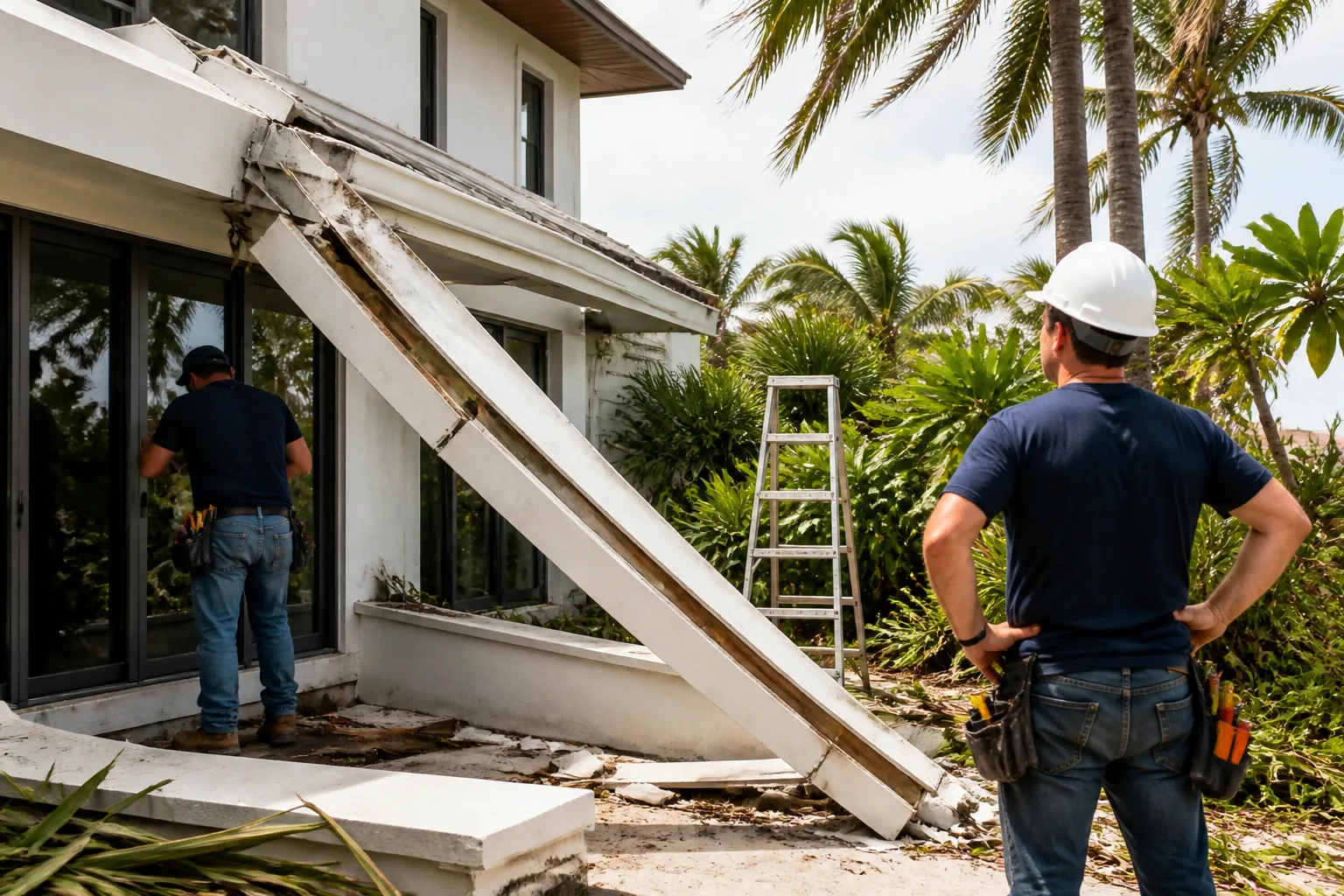
Emergency General Contractor Near Me: What Miami Beach Homeowners Should Do First
After a storm brushed past Miami Beach, the calls come in fast. We’ve watched homeowners sign emergency authorization forms the same afternoon, then discover later those verbal agreements had no guaranteed price, no defined scope, and no warranty language. The emergency call is exactly when you need written documentation most. Here’s what to do in the first thirty minutes, before you dial anyone.
If you’d rather have a trained eye walk you through it, call (844) 656-1986. A live person answers, day or night.
What Should You Do in the First Thirty Minutes of a Miami Beach Emergency?
Document before you touch anything, call your insurer before you hire anyone, refuse open-ended emergency authorizations, and isolate the damage without making it worse. That order matters. Doing it out of sequence is how claims get denied and warranties get voided.
Here’s the sequence we walk Miami Beach homeowners through:
- Record a slow video walkthrough. Pan every wall, ceiling, and floor. Narrate the date and time out loud. Photograph standing water with a ruler or tape measure in frame. Insurers want dimensions, not adjectives.
- Call your insurance carrier’s claims line and get a claim number before remediation starts. Ask specifically whether they require documentation from a licensed adjuster or public adjuster before debris removal.
- Do not sign an open-ended emergency authorization. If the form says “additional work as needed” with no dollar ceiling, you’ve just handed someone a blank check. More on this below.
- Isolate the affected area safely. Shut off water at the main if a pipe is burst. Kill power at the breaker to any wet ceiling or wall with visible electrical fixtures. Do not walk on a sagging ceiling or a spongy floor. Sandbag or divert water away from door thresholds.
One caveat worth saying plainly: if water is running into a wall cavity or a ceiling is bowing, stop filming and call a pro. A soaked drywall ceiling in a Miami Beach condo can weigh several hundred pounds before it lets go. That’s not a DIY moment.
When Does Miami-Dade Require a Permit, Even in an Emergency?
Most structural, electrical, plumbing, and roofing repairs in Miami-Dade still require a permit even when the work is urgent. The county does have an expedited process for storm-related damage, but “expedited” means a shorter review window, not a pass. Repairs to load-bearing walls, roof sheathing and framing, electrical service, and any gas or water line always need a permit pull.
What does the process actually look like? Miami-Dade’s Building Department runs a separate intake for emergency and storm-damage permits, and you’ll typically need:
- A written scope of damage signed by the property owner
- Photos of the affected area before any demolition
- A contractor license number on the application
- Product data sheets for roofing or structural materials if sheathing is being replaced
Cosmetic repairs (patching drywall, replacing a chunk of non-structural trim, re-sealing a window) generally don’t need a permit. Structural ones do, full stop. A contractor who tells you the county “won’t care” during storm season is telling you something about how they operate on a normal Tuesday, too.
If the damage reaches beyond a patch and into a full wall, floor, or ceiling rebuild, this is where our General Contractor in Miami Beach work starts – and where the permit conversation belongs at the front, not the back.
What Are the Red Flags in Emergency Contractor Solicitation?

The biggest red flag is a door-knocker with a clipboard and no written scope. After a major storm, out-of-town crews flood Miami Beach, and the sales pitch is always some version of “we can start today.” Starting today, without an inspection, without a written scope, without a price, is exactly backwards.
Watch for these:
- Pressure to sign before inspection. A legitimate contractor inspects first, then prices. If they want a signature to “hold your spot” before they’ve seen the damage, walk.
- Verbal-only damage assessments. “Looks like about ten grand” is not a scope. Any number that doesn’t include what’s torn out, what’s replaced, and what brand of materials is a guess dressed up as a bid.
- Cash-only with no paperwork. Legitimate contractors accept checks and cards and provide a written contract.
- No license number on the truck or the estimate. Miami-Dade requires contractors to display licensing; the number should be written on your estimate.
- “We have leftover materials from another job.” Sometimes true. Usually a way to quote you for materials that don’t match the grade you’d ever choose on purpose.
We pulled one out of a home near North Bay Road last season where the “emergency quote” was scribbled on the back of a business card and the number had grown by forty percent between day one and day four. The homeowner had signed it. She called us to ask what she could do about it. Not much – the signature was the problem.
What Does Your Insurance Company Need Documented Before Remediation Begins?
Your insurer needs photographic and video evidence of the pre-remediation condition of the damage, an inventory of affected items, and a claim number before any material is removed. Get this wrong and the claim is contested, sometimes denied outright. It’s the single most common mistake we see in Miami Beach emergency work.
Insurance adjusters are trained to spot what’s called “missing evidence” – damage that was cleaned up or repaired before they could see it. If your contractor hauls wet drywall to the curb before the adjuster photographs it, that claim line becomes a fight. Once the drywall is gone, the adjuster can’t evaluate whether the water reached the studs or the floor plate.
Here’s what to have on hand before anyone starts tearing out anything:
- Video walkthrough with timestamps
- Close-up photos of cracks, water lines, and any damaged roofing or exterior sheathing
- A list of personal property items affected (furniture, electronics, rugs)
- Your claim number and your adjuster’s name
- A written scope from the contractor before remediation starts, so the adjuster sees exactly what’s being removed and why
If your contractor can’t or won’t wait for the adjuster, that is a real problem. Insured, licensed contractors work alongside adjusters routinely.
How Do You Get a Written Scope and Price in an Emergency?

Ask for it in writing, and don’t start until you have it. Even in an emergency, a legitimate contractor will put a written scope and written price on paper before the first tool comes out of the truck. That may be a one-page document or a five-page one, but it will name what’s being removed, what’s being replaced, and what it costs.
Here’s the shape of a written emergency scope, if you’ve never seen one:
- Damage description. What failed, where, and what caused it (or what appears to have caused it).
- Removal and cleanup. What’s being torn out, hauled, and dried.
- Repair items, line by line. Materials named. CertainTeed or Owens Corning roofing, if roof work is involved, and the specific product line – not just “shingles.”
- Fixed price. A dollar number you can hold them to. Not a range. Not “starting at.”
- Guarantee language. What happens if the repair fails and who pays for the return visit.
At Penhallow, this is the written-price-before-work standard we hold on every job, and it doesn’t get waived because the ceiling is wet. The number on day one is the number on the invoice. And because we operate under The Kingswell Way – say the price before the work, show up in the window we gave, leave the place cleaner than we found it – the written guarantee is part of the paperwork, not an afterthought.
Related services in Miami Beach
When storm damage reaches into a kitchen or bath, the repair is often a remodel in disguise – water behind tile usually means Bathroom Remodeling in Miami Beach, and a soaked cabinet run usually means Kitchen Remodeling in Miami Beach once the drying is done. Our Penhallow Remodeling Miami Beach home page lays out the full scope, and we’re happy to walk you through what a rebuild looks like once the insurance piece settles.
When Should You Call a Pro Immediately?
Call immediately when water is actively entering a wall or ceiling, when anything structural has shifted (a crack that wasn’t there yesterday, a door that won’t latch, a floor that flexes), when you smell gas, or when you see visible sparks or darkened outlets near wet areas. Do not attempt the repair yourself. Electrical, gas, and structural work carries real risk of injury, and a DIY patch on a load-bearing wall can void both your insurance claim and any future contractor warranty.
For everything else – a cracked tile, a soaked rug, a damaged window trim – document, call your insurer, and take your time finding the right contractor. Miami Beach doesn’t get many chances to slow down. Take this one.
The Bottom Line
In a Miami Beach construction emergency, the first thirty minutes decide a lot. Document everything, get a claim number, refuse open-ended authorizations, and insist on a written scope and a written price before anyone touches a tool. A contractor who won’t put a price and a guarantee in writing during an emergency is telling you exactly how they’ll operate when the pressure’s off. Penhallow Remodeling Miami Beach provides free estimates, written prices before work starts, background-checked uniformed technicians, and the 365-Day Done Right Promise on every project – if the work fails inside the guarantee period, we come back and fix it at no charge. Call (844) 656-1986 to schedule your free estimate.
Frequently Asked Questions
It depends on scope. Water damage drying and drywall repair typically runs $1,800-$6,500 for a single room; structural roof repairs after storm damage often land between $4,000 and $18,000 depending on roof pitch and sheathing; full wall rebuilds involving framing, sheathing, and finish can run $12,000-$30,000. Call (844) 656-1986 for an exact written quote – estimates are free.
Not on structural or permit-required repairs – those need an inspection and a written scope first, and pulling a Miami-Dade permit takes time even on the expedited track. Emergency stabilization work (tarping, water shutoff, temporary shoring) can happen quickly, but the actual repair is a planned job, not a same-day one. Call (844) 656-1986 to schedule your free estimate.
It can be. Insurers need photographic evidence of the pre-remediation condition, and repairing before the adjuster photographs the damage is one of the most common reasons claims get contested. Document everything first, then arrange a written scope, then let the adjuster see it. Call (844) 656-1986 with questions – we’re happy to walk through documentation.
Yes. Any emergency repair that touches structure, roofing, electrical, plumbing, or gas in Miami-Dade requires a permit, and we pull it and pass the inspection as part of the job. Call (844) 656-1986 to schedule your free estimate.
No. Every Penhallow project gets a written price before any work starts, and the number on day one is the number on the invoice – no change orders for surprises we should have caught during inspection. Call (844) 656-1986 to schedule your free estimate.
Written by the team at Penhallow Remodeling Miami Beach.
Need Construction Help?
Call Penhallow Remodeling Miami Beach - licensed & insured, here with fast after-hours help in Miami Beach.
(844) 656-1986